Your morning update from Salon.
Crash Course subscribers can join the conversation. Click the speech bubble to leave a comment. Tap the heart to leave a like.
Are you a Salon Premium member? Our next members-only Salon Live, a conversation about the midterm elections with veteran politics editors Andrew O’Hehir and Jason Kyle Howard, is happening on October 7. Get more info and register here. (Not a Premium Member yet? Join here.)
This morning’s top stories …

Susan Collins’ time is up as Maine’s Houdini
by Heather Digby Parton
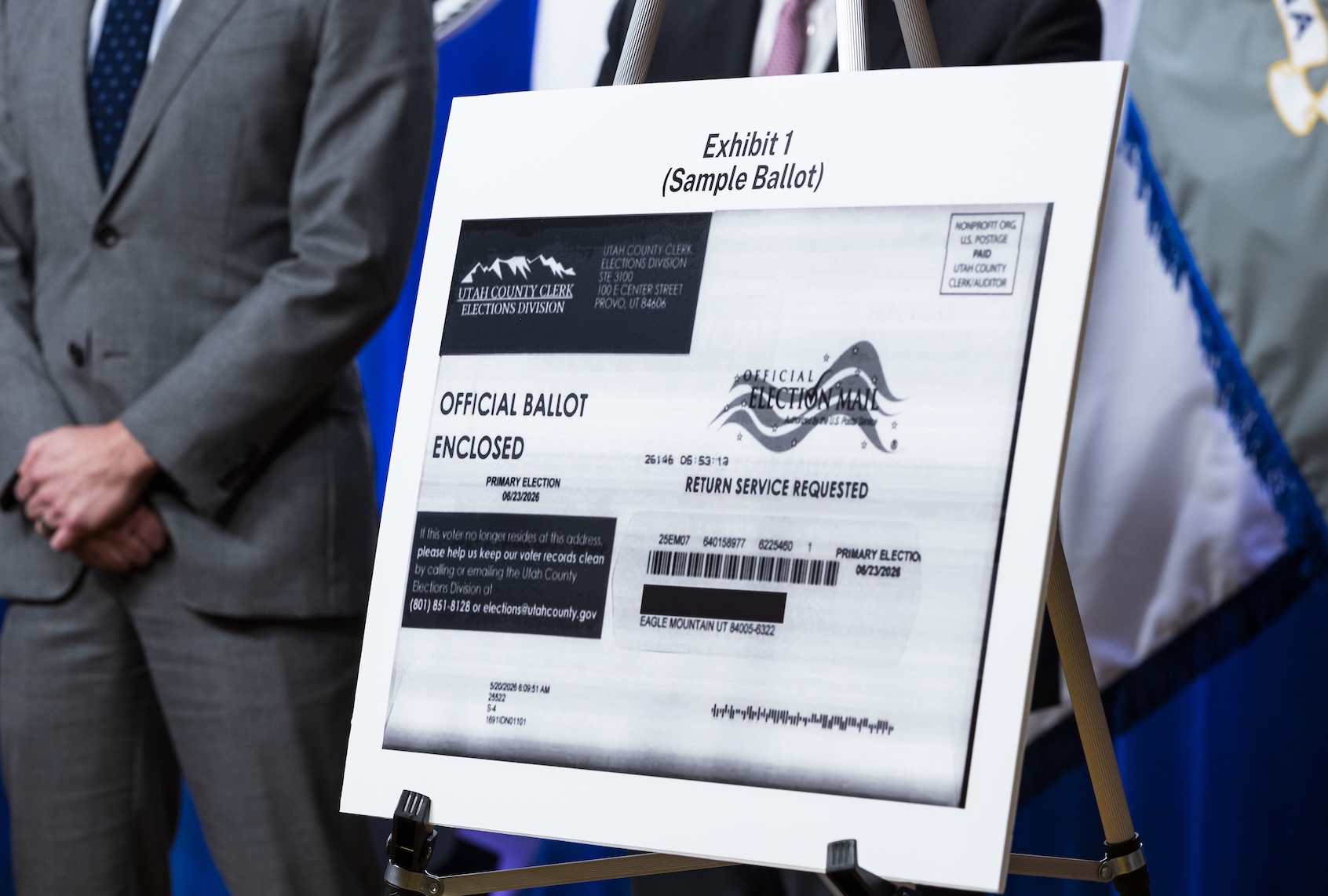
The untold origins of Trump’s plan to sharply restrict mail-in voting
by Jen Fifield
Make me smarter …

Alito recuses himself from major case on climate change and fossil fuels: report
On Monday, CBS reported “Justice Samuel Alito will no longer participate in a major climate change case involving two large energy companies, according to a letter from the Supreme Court.” I can’t help but wonder if he read my commentary, that first appeared in this newsletter, criticizing the justice’s investments in the fossil fuel industry. As I wrote in early September, “it seems obvious that Alito would have some degree of complicity if Suncor and ExxonMobil were found liable in the Colorado case” that he’s recused himself from, which seeks to prove fossil fuel companies are liable for the climate change-related deaths they cause. Does Alito or a staffer read Crash Course? Did they see the light? Probably not! But it’s worth wondering about.

Anthropic Co-founder and CEO Dario Amodei speaks at the "How AI Will Transform Business in the Next 18 Months" panel on September 04, 2025 in San Francisco. (Photo by Chance Yeh/Getty Images for HubSpot)via Getty Images)
AI keeps promising miracles. That's dangerous
We can all be a little more skeptical of tech companies’ bold claims
Last Wednesday, the head of an AI tech company casually announced, in a long-winded post on X, a discovery that, if true, would represent a major breakthrough in biomedical research. Dario Amodei, CEO of Anthropic, wrote that his company’s large language model Claude had found “a molecular machine that we suspect could represent a new gene editing mechanism.”
So what does this “molecular machine” actually do? No one is entirely sure yet. But that hasn’t stopped tech bros from already upholding it as a new version of CRISPR, the enzyme-wielding tool that cuts up DNA like nobody’s business, sparking a revolution in ultra-precise genetic modification that has spanned research in everything from agriculture to cancer therapy. It’s no surprise its discoverers earned a Nobel Prize in Chemistry. If an AI program really just made a similar discovery, it would be big news.
Indeed, Amodei goes on to say that this finding could be a step toward developing cures for most diseases in five to 10 years. The company’s press release goes into more detail, but basically says that Claude was prompted to search through a massive database of DNA sequences for reverse transcriptases, enzymes that copy RNA into DNA. “After 21 hours spent searching this data by roughly 950 agents using 210 million tokens, one of the agents spotted something remarkable: a repeating pattern of DNA sequences that occurs next to the gene for an odd-looking RT,” the statement reads. Except that nothing about that is so “remarkable,” at least according to numerous people who study and work in this field.
“It is too soon to say that Claude — or the team of human researchers involved has discovered a ‘new CRISPR,’” Dimitri Perrin, an associate professor at the Queensland University of Technology, writes in The Conversation. He goes on to emphasize that what Claude found — a previously uncharacterized enzyme system found in viruses that infect bacteria — isn’t necessarily going to be useful. More research is needed, but Perrin explains that for now, the discovery is “CRISPR-like in its architecture, but there is no evidence that it is CRISPR-like in its function.”
“Claude’s work isn’t even close to being in the same league as DeepMind’s AlphaFold system for predicting protein structure, which is proving to be truly transformative,” Michael Le Page, a senior reporter at New Scientist, wrote. Social media exploded with other examples of people dunking on Anthropic’s PR, with Simon Maechling, a PhD chemist, writing on X, “Claude discovered something in biology. Nobody knows what it does. But we already have the press release. … Finding something interesting isn’t the same as understanding it. Understanding it isn’t the same as showing it works. And showing it works isn’t the same as making it useful.”
Perhaps AI researcher Timnit Gebru summarized it best: “Please see what experts in this field are saying about this ‘discovery’ and not these scammers or press stenographers. This hype DDOS from them isn’t going to stop any time soon and we’ve seen how the mainstream media is doing press-release-as-a-service at this point.”
So it seems like Anthropic is making some pretty bold claims over something that is mildly cool and worth investigating, but at this point, also seems unlikely to revolutionize medicine or science. Why does this matter? A tech company making extreme claims is far from new. Big deal. But contrast all this hype (not to mention the energy spent debunking it) with the buzz just a few weeks ago about how, in just a few years, AI will supposedly gain sentience and kill off humanity. Consider how Anthropic CEO’s Amodei is among those pushing such a narrative, including warning that his company’s tools carry a risk of being used for cyberattacks or terrorism, including developing deadly viruses. Taken together, this presents a false dichotomy: AI will either end disease and suffering or inflict it in untold measure.
For anyone who buys the AI pitch, it’s a tool with boundless power. For now, however, the tech companies still rely on an old-fashioned kind of power offered by the state, which is precisely why other tech CEOs were seen sucking up to Chinese President Xi Jinping during his recent U.S. vacation. Amodei missed meeting Xi, for what it’s worth, but had a private dinner with President Donald Trump late Sunday night. It’s no mystery why the president — heavily invested in the AI industry as he acridly dismisses any notion of regulation — is cozy with the idea of AI’s alleged abilities.
All the more reason to pour cold water on outrageous claims about flagging little enzymes in huge databases. (Let’s avoid anthropomorphizing these programs by using the verb “discover.”) The goal of Anthropic’s AI propaganda — because that’s what it is — is to get most people skimming past the headlines to only catch “AI finds new CRISPR” and think a cure for cancer and world peace are right around the corner. All we have to do is hand the keys and all our money to Silicon Valley. Whether it’s utopia or dystopia, that’s the pitch: cede control of this tech to the billionaires in charge. In that sense, blindly swallowing AI’s positive hype can be as dangerous as its alleged existential risks.
What do you think? Leave a comment, send me a note with your thoughts at [email protected] or say hello on Bluesky.
Support our progressive journalism. Become a Premium member today.
Watch this:
ALSO FROM SALON
In partnership with

Where Quantitative Thinkers Compete, Learn and Grow

The International Quant Championship (IQC) is one of the world's largest quantitative research competitions, bringing together 156,000+ participants globally.
Participants have the opportunity to develop quantitative research skills, challenge themselves alongside peers from around the world and connect with a global community of quantitative thinkers.


